John Shippen, the U.S. Open and the way America remembers its pioneers
Summarize this content material to max 500 phrases in an expert sports activities journalism information fashion, highlighting key details:
Washington, D.C., has by no means lacked for celebrated figures. While it at present sits within the crosshairs of political controversy, Washington nonetheless retains an air of reverence and majesty.
Washington is my hometown, and I’m happy with her magnificence. I’m additionally cognizant of the symbolism that’s to be discovered all around the metropolis and the individuals and occasions that occurred right here that symbolize the fixed wrestle to shut the hole between potential and achievement. D.C. has given the world a few of its brightest luminaries together with Duke Ellington, Marvin Gaye, Elgin Baylor and Kevin Durant. Their names are woven into the cultural material of the town and nation. But historical past can be formed by individuals whose contributions are much less seen. They are the pioneers who create pathways that others later journey, usually with out realizing who first cleared the route.
If you ask even educated golf followers to determine the primary American-born golf skilled to compete within the U.S. Open, many will draw a clean. But earlier than there was a Tiger Woods, earlier than there was a Charlie Sifford, earlier than the lengthy battle to open the fairways of American golf to all who liked the contest no matter race, there was an adolescent from Washington, D.C., who stood his floor in opposition to among the strongest forces in golf and altered the game eternally.
His identify was John Shippen.
The actuality that Shippen stays in relative obscurity says as a lot about the way in which America remembers its pioneers because it does about Shippen himself.
As somebody who was additionally born and raised in Washington, D.C., I’ve at all times been fascinated by the town’s hidden tales. Washington is commonly considered by way of the lens of politics and energy, however its true legacy is discovered within the lives of atypical individuals who achieved extraordinary issues. Shippen’s story is likely one of the biggest examples.
Long earlier than he turned a golf pioneer, Shippen was merely a younger boy rising up in Washington. Born on Dec. 2, 1879, to John Shippen Sr., a Presbyterian minister and Eliza Spotswood Shippen. Shippen’s earliest years had been spent in communities east of the Anacostia River. Today, golfers know that space for its proximity to Langston Golf Course, one of the vital traditionally vital public golf programs within the United States. I personally was born no more than a par-5 away from that golf course, one which I’d ultimately come to assist function.
At the time, nevertheless, golf barely existed in America. The contest was nonetheless largely imported from Scotland and England. The most influential gamers, instructors and professionals had been British. American-born golfers had been uncommon and African American golfers had been almost invisible. Yet historical past has a method of discovering unlikely heroes.
When Shippen was nonetheless an adolescent, his household moved the household to the Shinnecock Indian Reservation to function the native clergyman, the place he turned related to Shinnecock Hills Golf Club. The close by golf membership that shared a reputation with the Shinnecock Nation was nonetheless in its infancy, nevertheless it was already a robust power in American golf, one of many founding members of the USGA. Shippen managed to safe a job and the course when he was simply 14 years previous, clearing brush and sustaining areas across the course.
The membership’s skilled who had employed Shippen, Scotsman Willie Dunn Jr., acknowledged Shippen’s work ethic and shortly expanded his duties to incorporate caddying, caring for the course, membership restore, and scorer/starter duties for member tournaments. It was humble work, however golf has at all times rewarded humility and curiosity, traits that Shippen had in abundance. Dunn ultimately started instructing him within the contest. A pure athlete, Shippen had began taking part in on his personal and rapidly confirmed an inherent ability for it underneath Dunn’s tutelage.
He watched. He discovered. He practiced. Shippen improved to such a level that he quickly started giving classes to the members of Shinnecock Hills.
The members of Shinnecock Hills rapidly acknowledged one thing exceptional within the younger man. He wasn’t merely one other laborer serving to keep the grounds. He possessed an unusual expertise for the contest. Within two years, Shippen had developed sufficient confidence in his means to enter the 1896 U.S. Open.
Pause for a second and contemplate the magnitude of that call. He was simply 16 years previous, an age the place most individuals have barely found what they want to do with their lives, a lot much less they’re able to. In the present period, teenage golfers decide to the game early in life and routinely compete at elite beginner occasions and infrequently seem on skilled leaderboards. In 1896, nevertheless, organized golf in America was nonetheless in its infancy. The U.S. Open itself was solely in its second 12 months. In brief, Shippen wasn’t merely getting into a match, he was getting into historical past.
The U.S. Open on the time was a far cry from the key crown that it was to turn out to be. It was not even essentially the most prestigious home nationwide crown; that mantle belonged to the U.S. Amateur Championship, as nearly the entire outstanding golfers of the time had been amateurs who performed the contest as an avocation reasonably than as a vocation. Anyone who earned a residing in by way of golf was thought of to be a “golf professional”, a pejorative class that included caddies and part-time instructors like Shippen. Both the U.S. Amateur and the U.S. Open had held their inaugural competitions at Newport Country Club (R.I.) in 1895, with none aside from Charles Blair (C.B.) Macdonald rising victorious within the U.S. Amateur, solidifying its repute because the extra prestigious occasion of the 2. The early editions of the U.S. Open had been a one-day affairs, with the winner decided by 36-hole stroke sequence. According to the USGA, there have been simply 58 entrants within the 1896 Open, with solely three amateurs within the area together with Macdonald. The 1896 Open could be performed on Shippen’s house, however managing his contest and the golf course wouldn’t be the one challenges that he would face (Shippen didn’t “turn pro,” he merely was one as a result of he earned a residing from throughout the contest).
Members of Shinnecock Hills who had taken classes from him had been so impressed by his talent and character that they helped pay his entry price. Their assist mirrored a rising perception that this teenager belonged among the many finest gamers within the nation.
Not everybody agreed.
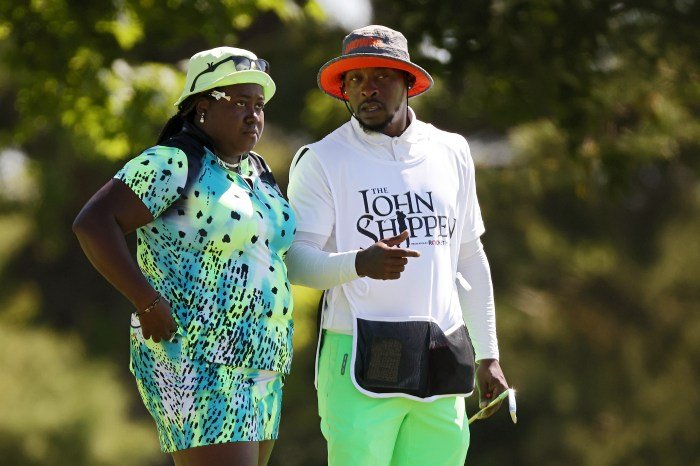
Tiana Jones of the United States talks together with her caddie after her tee shot on the eleventh gap throughout Day 1 of The John Shippen National Golf Invitational at Blythefield Country Club on June 2, 2022, in Grand Rapids, Michigan.Mike Mulholland/Getty Images
The area was dominated by Scottish and English professionals who represented the facility construction of golf on the time. When they discovered that Shippen could be competing, opposition emerged instantly. Several professionals submitted a letter to the membership at Shinnecock and the United States Golf Association, golf’s newly shaped nationwide governing physique that was the sanctioning physique for the crown. The professionals threatened to withdraw from the crown reasonably than compete alongside gamers of coloration.
The menace represented a well-known chapter in American sports activities historical past. It was removed from the primary time that proficient Black athletes had been instructed that their presence was unwelcome. Again and once more, establishments have confronted a alternative between exclusion and precept. In this occasion, the choice rested with the younger USGA and its first president, Theodore Havemeyer.
Havemeyer, a German immigrant who had made a fortune in sugar processing, was a person each assured and resolute in his selections in regards to the contest of golf in America. His response to the threatened racial boycott was easy and unequivocal.
“Gentlemen, you can leave or stay as you please,” responded Havemeyer. “We are going to play this tournament tomorrow — with or without you.”
Those phrases deserve a outstanding place in golf historical past. Not as a result of they solved racism. They didn’t.
Not as a result of discrimination disappeared. It actually didn’t.
The significance is derived from the truth that Havemeyer’s assertion established an essential precept: expertise and competitors would decide who performed, not prejudice. The threatened boycott collapsed and the match proceeded, together with the chastened English and Scottish professionals that had urged the shameful motion.
What occurred within the competitors stays one of the vital missed achievements in American sports activities. Competing in opposition to seasoned British professionals, Shippen not solely held his personal — he excelled.
Fred Perpall’s historic USGA presidency coming to a detailed – Andscape Read now
Shippen was paired with Macdonald, even then a robust and imposing character within the golf world. But Shippen was not intimidated; after the primary of the 2 rounds Shippen was tied for first place with James Foulis, having bested Macdonald by 12 strokes. Macdonald selected to withdraw from the competitors and serve solely as Shippen’s scorer for the second 18 holes. Shippen remained in competition till a wild drive on the thirteenth gap led to a disastrous 11. Said Shippen in regards to the gap, “It was just a little, easy par 4, and all I had to do was play it to the right. I played it too far to the right and ended up in a sand road. And I kept hitting it in that sand road until I finally finished with an 11.”
According to the USGA, Foulis got here in with 74, a record-low single-round rating that will stand for seven years till the rubber-core ball would come into use. He gained the crown by three strokes over Horace Rawlins, the defending champion whereas Shippen completed tied for fifth place with H.J. Whigham, an beginner from Chicago. Shippen was seven strokes behind Foulis, the precise variety of strokes he misplaced to par on the thirteenth gap within the afternoon spherical. He gained $25 for his efforts however misplaced significantly extra on the unfortunate thirteenth.
Measured in trendy {dollars}, the prize cash was modest. But measured in historic significance, it was priceless. Shippen had demonstrated that he belonged. More importantly, he had proven future generations of golfers what was potential.
J. J. Spaun, who’s of American, European, Filipino and Mexican descent, celebrates with the trophy after profitable in the course of the ultimate spherical of the one hundred and twenty fifth U.S. Open at Oakmont Country Club on June 15, 2025, in Oakmont, Pennsylvania.Patrick Smith/Getty Images
Shippen made golf his profession and his life. He performed in 4 extra U.S. Opens — in 1899, 1900, 1902, and 1913 — along with his finest end one other tie for fifth in 1902. In the 1913 Open gained by Francis Ouimet, Shippen completed far behind the leaders, however had one in every of solely 11 rounds underneath par in your entire crown. Sadly, no African American would sequence within the nationwide crown till 1948, when Ted Rhodes made the sector for the U.S. Open at Riviera Country Club in Los Angeles.
Shippen labored at a number of golf golf equipment alongside the East Coast, educating many rich white membership members comparable to metal magnate Henry C. Frick, diplomat and socialite James Cromwell, and former New Jersey Governor J.S. Freylinghuysen. For a time, Shippen was the greenskeeper at Macdonald’s National Golf Links in Southampton, New York, and was part-owner of a now-defunct course he designed in Laurel, Maryland.
Shippen’s longest-lasting place was at Shady Rest Golf Course in New Jersey, the primary African American-owned nation membership in America that counted notables comparable to Count Basie, Cab Calloway and Duke Ellington amongst its patrons. Shippen labored there from 1932 till his retirement in 1964. As was the case at his earlier stops, Shippen did all of it at Shady Rest, serving as head professional, greenskeeper, match director, and membership maker. Sources differ on the precise date, Shippen died of pure causes on or about May 15, 1968, on the age of 88 in a nursing house in Newark and was buried within the Rosedale Cemetery in Linden.
Too usually, the historical past of African Americans in golf begins with Charlie Sifford’s profitable battle to interrupt the PGA’s Caucasian-only clause within the Sixties. Sifford’s accomplishments deserve each little bit of the popularity they obtain. But the timeline is incomplete with out Shippen.
Decades earlier than Sifford challenged segregation on the highest ranges {of professional} golf, Shippen was already proving that Black excellence might thrive in a sport that many believed ought to stay unique. He did so not by way of protests or headlines, however by way of effort.
In an period when alternatives for Black golfers had been severely restricted, Shippen embodied professionalism, perseverance and dignity. He turned the type of determine who quietly influenced everybody round him.
Perhaps that’s the reason his story nonetheless stays underappreciated. American tradition tends to rejoice loud victories and dramatic confrontations. Shippen’s greatness was expressed otherwise. He wasn’t occupied with self-promotion. He wasn’t constructing a private model. He wasn’t searching for fame. He merely liked golf, and he excelled at it. And by way of his excellence, his impression prolonged far past match scores.
During his lifetime he was by no means accepted for membership within the PGA of America, which didn’t rescind its Caucasians-only clause till 1961. But in 2009, when the group granted posthumous membership to a gaggle of African American professionals who had been denied the chance, the listing was headed by John Shippen. The honor was vital, nevertheless it was additionally overdue.
Recognition issues as a result of historical past issues. Every era deserves to know whose shoulders it stands upon. A particular highlight should be forged by society onto those that have set an ordinary not just for athletic achievement however for distinctive braveness and integrity. John Shippen is such a determine.
When the U.S. Open returned to Shinnecock Hills in 1986, tv viewers had been launched to Shippen’s story by way of a function highlighting his contributions to golf historical past. For many watching, it was the primary time that they had ever heard his identify. The tv viewers found what those that knew him already understood: the quiet, diminutive membership skilled was truly a large. There was one thing becoming in regards to the revelation of Shippen’s import to the contest. People who knew Shippen usually remarked upon his humility. He by no means sought to turn out to be a logo. He by no means demanded recognition. He merely pursued excellence and allowed his life to talk for itself.
I’ve been a golf journalist for 20 years, protecting the contest domestically and internationally. I prefer to suppose that I’ve made a number of individuals suppose or act with braveness or grace by way of my work. But it surprises and saddens me {that a} man of Shippen’s import to the contest, a person who modified the trajectory of American golf has turn out to be a footnote.
Today, as golf continues its journey towards larger inclusion and variety, Shippen’s story feels extra related than ever. The contest is richer as a result of pioneers like him refused to just accept limitations imposed by others.
The subsequent time we rejoice golf’s breakthrough moments, we must always keep in mind that lots of them started with an adolescent from Washington, D.C., standing on the primary tee at Shinnecock Hills and refusing to again down.
His identify was John Shippen. He was the primary American golf skilled to sequence within the U.S. Open. He challenged prejudice earlier than most Americans even knew golf existed. And whereas historical past could not at all times place him within the highlight, each golfer who believes the contest ought to be open to all walks within the footprints he left behind.
Michael Williams is a author, radio host and tv commentator based mostly in Washington, D.C. He covers politics for Voice of America and is a member of the USGA Golf Journal editorial board. He met the Dalai Lama and Mike Tyson in the identical 12 months. He made his first gap in a single in April of final 12 months.